TL431, what kind of "beast" is this?

Fig. 1 TL431.
TL431 was created in the late 70's and is currently widely used in industry and in amateur radio activity.
But despite her solid age, not all radio amateurs are intimately familiar with this wonderful body and its capabilities.
In the proposed article I will try to acquaint the radio amateurs with this chip.
First, let's see what's inside it and turn to the documentation for the microcircuit, the "datasheet" (by the way, the analogs of this chip are KA431, and our chips KR142EN19A, K1156ER5x).
And inside it has a dozen transistors and only three conclusions, so what is it?
But despite her solid age, not all radio amateurs are intimately familiar with this wonderful body and its capabilities.
In the proposed article I will try to acquaint the radio amateurs with this chip.
First, let's see what's inside it and turn to the documentation for the microcircuit, the "datasheet" (by the way, the analogs of this chip are KA431, and our chips KR142EN19A, K1156ER5x).
And inside it has a dozen transistors and only three conclusions, so what is it?

Fig. 2 Device TL431.
It turns out all very simple. Inside is a conventional op-amp operational amplifier (a triangle in a block diagram) with an output transistor and a reference voltage source.
Only here this circuit plays a slightly different role, namely, the role of the zener diode. It is also called the "Controlled Zener diode".
How does he work?
See the block diagram of TL431 in Figure 2. It is seen from the diagram that the op-amp has a (very stable) built-in 2.5v reference voltage source (small square) connected to the inverse input, one direct input (R), a transistor at the OU output, a collector K) and emitter (A), which are combined with the power outputs of the amplifier and a protective diode from the reverse polarity. The maximum load current of this transistor is up to 100 mA, the maximum voltage is up to 36 volts.
Only here this circuit plays a slightly different role, namely, the role of the zener diode. It is also called the "Controlled Zener diode".
How does he work?
See the block diagram of TL431 in Figure 2. It is seen from the diagram that the op-amp has a (very stable) built-in 2.5v reference voltage source (small square) connected to the inverse input, one direct input (R), a transistor at the OU output, a collector K) and emitter (A), which are combined with the power outputs of the amplifier and a protective diode from the reverse polarity. The maximum load current of this transistor is up to 100 mA, the maximum voltage is up to 36 volts.

Fig. 3 The pinout is TL431.
Now, using the example of a simple diagram depicted in Figure 4, we will analyze how this works.
We already know that inside the chip there is a built-in reference voltage source - 2.5 volts. The first releases of microcircuits, which were called TL430 - the voltage of the built-in source was 3 volts, in later releases, it reaches 1.5 volts.
Therefore, in order to open the output transistor, it is necessary to input the input amplifier (R), supply voltage - slightly exceeding the reference 2.5 volts, (the prefix "a little" can be omitted, since the difference is several millivolts and in the future we will assume that on the input you need to apply a voltage equal to the reference one), then the output of the operational amplifier will appear voltage and the output transistor will open.
To put it simply, the TL431 is something like a field effect transistor (or simply a transistor), which opens at a voltage of 2.5 volts (or more) applied to its input. The threshold for opening and closing the output transistor here is very stable due to the presence of a built-in stable reference voltage source.
We already know that inside the chip there is a built-in reference voltage source - 2.5 volts. The first releases of microcircuits, which were called TL430 - the voltage of the built-in source was 3 volts, in later releases, it reaches 1.5 volts.
Therefore, in order to open the output transistor, it is necessary to input the input amplifier (R), supply voltage - slightly exceeding the reference 2.5 volts, (the prefix "a little" can be omitted, since the difference is several millivolts and in the future we will assume that on the input you need to apply a voltage equal to the reference one), then the output of the operational amplifier will appear voltage and the output transistor will open.
To put it simply, the TL431 is something like a field effect transistor (or simply a transistor), which opens at a voltage of 2.5 volts (or more) applied to its input. The threshold for opening and closing the output transistor here is very stable due to the presence of a built-in stable reference voltage source.

Fig. 4 Scheme on the TL431.
From the circuit (Figure 4), it is seen that the input R of the TL431 chip, the voltage divider from the resistors R2 and R3 is switched on, the resistor R1 limits the LED current.
Since the resistors of the divider are the same (the voltage of the power supply is divided in half), the output transistor of the amplifier (TL-ki) will open at a voltage of 5 volts or more (5/2 = 2.5). At the input R in this case, 2.5 volts will be fed from the divider R2-R3.
That is, the LED at us will light up (the output transistor will open) at a voltage of a power source - 5 volts and more. It will die out accordingly when the voltage of the source is less than 5 volts.
If you increase the resistance of the resistor R3 in the divider's arm, it will be necessary to increase the voltage of the power supply by more than 5 volts, so that the voltage at the input R of the microcircuit from the divider R2-R3 again reaches 2.5 volts and the output transistor TL opens -yes.
It turns out that if this voltage divider (R2-R3) is connected to the output of the PSU and the cathode of the TLK to the base or gate of the regulating transistor BP, then changing the divider arms, for example by changing the value of R3 - it will be possible to change the output voltage of this PSU, because at the same time, the stabilization voltage of the TL-ki (the opening voltage of the output transistor) will change - that is, we get a controlled zener diode.
Or if you choose a divider without changing it in the future - you can make the output voltage of the PSU strictly fixed for a certain value.
Conclusion; - If the microcircuit is used as a zener diode (its main purpose), then we can make a zener diode with any stabilization voltage within 2.5-36 volts (the maximum limitation in "datasheet") by choosing the resistor of the R2-R3 divider.
The voltage of stabilization in 2.5 volts is obtained without a divider if the TL input is connected to its cathode, that is, to close conclusions 1 and 3.
Then there are still questions. can I for example replace the TL431 with a regular opamp?
- It is possible only if there is a desire to design, but it will be necessary to assemble its reference voltage source by 2.5 volts and supply power to the opamp separately from the output transistor, since the current of its consumption can open the actuator. In this case, you can make the reference voltage anything (not necessarily 2.5 volts), then you will need to recalculate the divider resistors used in conjunction with the TL431, so that at a given output voltage of the PSU, the voltage applied to the input of the chip is equal to the reference voltage.
One more question - is it possible to use TL431 as a normal comparator and assemble on it, say, a thermoregulator, or something like that?
- It is possible, but since it differs from the usual comparator already by the presence of a built-in reference voltage source, the circuit will be much simpler. For example, such;
Since the resistors of the divider are the same (the voltage of the power supply is divided in half), the output transistor of the amplifier (TL-ki) will open at a voltage of 5 volts or more (5/2 = 2.5). At the input R in this case, 2.5 volts will be fed from the divider R2-R3.
That is, the LED at us will light up (the output transistor will open) at a voltage of a power source - 5 volts and more. It will die out accordingly when the voltage of the source is less than 5 volts.
If you increase the resistance of the resistor R3 in the divider's arm, it will be necessary to increase the voltage of the power supply by more than 5 volts, so that the voltage at the input R of the microcircuit from the divider R2-R3 again reaches 2.5 volts and the output transistor TL opens -yes.
It turns out that if this voltage divider (R2-R3) is connected to the output of the PSU and the cathode of the TLK to the base or gate of the regulating transistor BP, then changing the divider arms, for example by changing the value of R3 - it will be possible to change the output voltage of this PSU, because at the same time, the stabilization voltage of the TL-ki (the opening voltage of the output transistor) will change - that is, we get a controlled zener diode.
Or if you choose a divider without changing it in the future - you can make the output voltage of the PSU strictly fixed for a certain value.
Conclusion; - If the microcircuit is used as a zener diode (its main purpose), then we can make a zener diode with any stabilization voltage within 2.5-36 volts (the maximum limitation in "datasheet") by choosing the resistor of the R2-R3 divider.
The voltage of stabilization in 2.5 volts is obtained without a divider if the TL input is connected to its cathode, that is, to close conclusions 1 and 3.
Then there are still questions. can I for example replace the TL431 with a regular opamp?
- It is possible only if there is a desire to design, but it will be necessary to assemble its reference voltage source by 2.5 volts and supply power to the opamp separately from the output transistor, since the current of its consumption can open the actuator. In this case, you can make the reference voltage anything (not necessarily 2.5 volts), then you will need to recalculate the divider resistors used in conjunction with the TL431, so that at a given output voltage of the PSU, the voltage applied to the input of the chip is equal to the reference voltage.
One more question - is it possible to use TL431 as a normal comparator and assemble on it, say, a thermoregulator, or something like that?
- It is possible, but since it differs from the usual comparator already by the presence of a built-in reference voltage source, the circuit will be much simpler. For example, such;

Fig. 5 Thermostat on the TL431.
Here the thermistor (thermistor) is a temperature sensor, and it reduces its resistance when the temperature rises, i.e. has a negative TCR (Temperature Coefficient of Resistance). Thermoresistors with positive TCR, i.e. the resistance of which increases with increasing temperature - called posistors.
In this thermoregulator, when the temperature exceeds the set temperature (regulated by a variable resistor), the relay or some kind of actuator will operate, and disconnect the load (s) from the contacts, or for example turn on the fans depending on the task.
This circuit has a small hysteresis, and to increase it, it is necessary to introduce an OOS between terminals 1-3, for example a tuning resistor of 1.0-0.5 mΩ and its value to be determined experimentally, depending on the necessary hysteresis.
If it is necessary for the actuator to operate when the temperature is lowered, then the sensor and regulators need to be reversed, that is, insert the thermistor into the upper arm and the alternating resistance with the resistor into the lower arm.
And finally, you can easily figure out how the TL431 chip works in the power supply circuit for the transceiver, which is shown in Figure 6, and what role the R8 and R9 resistors play, and how they are selected.
In this thermoregulator, when the temperature exceeds the set temperature (regulated by a variable resistor), the relay or some kind of actuator will operate, and disconnect the load (s) from the contacts, or for example turn on the fans depending on the task.
This circuit has a small hysteresis, and to increase it, it is necessary to introduce an OOS between terminals 1-3, for example a tuning resistor of 1.0-0.5 mΩ and its value to be determined experimentally, depending on the necessary hysteresis.
If it is necessary for the actuator to operate when the temperature is lowered, then the sensor and regulators need to be reversed, that is, insert the thermistor into the upper arm and the alternating resistance with the resistor into the lower arm.
And finally, you can easily figure out how the TL431 chip works in the power supply circuit for the transceiver, which is shown in Figure 6, and what role the R8 and R9 resistors play, and how they are selected.
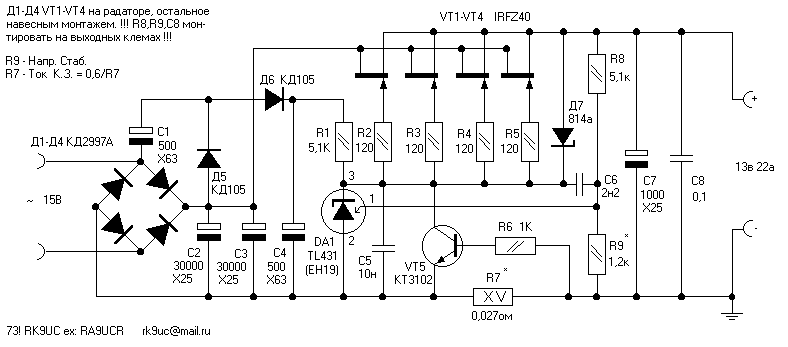
Fig. 6 Powerful power supply for 13 volts, 22 amps


2 comments: